Buffalobet

Roulette Online: Rules, Live Dealer Games and Strategies

"Understanding roulette begins with its mathematical structure, not headline promotions. Whether playing a free roulette demo or evaluating live dealer tables, a player's first priority should always be examining the terms, verifying regulatory compliance, and understanding how the house edge operates across different wheel layouts." — Claire Bennett, Senior iGaming Content Editor

Last reviewed and updated: June 2026 | Author: Claire Bennett, Senior iGaming Content Editor | Audience: Australian readers aged 18+

Provider

Evolution

RTP

97.30%

Volatility

Low

Min bet

$0.01

Max bet

$20,000

Max win

35x

Roulette Online Rules, Live Dealer Games
Table of ContentCloseOpen
Roulette in Sixty Seconds The Short

Roulette in Sixty Seconds: The Short Version

  • Choose single-zero wheels. European roulette (37 pockets) carries a 2.70% house edge. American roulette (38 pockets, with both 0 and 00) doubles it to 5.26%. French roulette with La Partage cuts the edge on even-money bets to just 1.35%, the lowest figure available anywhere in the game.
  • No betting system beats the maths. Martingale, Fibonacci, D'Alembert, the James Bond spread and the Andrucci System only redistribute variance. Every spin is an independent event, and table maximums cap every progression.
  • Payouts are deliberately short. A straight-up win pays 35 to 1 while the true odds are 1 in 37, producing an expected value of −$0.027 per $1 wagered on a European wheel.
  • Australian law matters before you deposit. Interactive casino-style gaming is restricted under the Interactive Gambling Act 2001. The ACMA blocks unlicensed offshore sites, and credit cards and digital currencies have been banned for licensed online wagering since June 2024.
  • Roulette is a poor bonus-clearing game. Table games typically contribute only 5% to 10% toward wagering requirements, and plenty of promotions exclude roulette entirely.
  • Demo first, real money later. Free play teaches layout and pacing at zero cost, but it never changes the underlying house edge. Not once.

What Is Roulette and How Does the Roulette Wheel Work?

Roulette is a casino game played on a circular wheel divided into numbered, coloured pockets. A small ball is spun in the opposite direction of the wheel to determine the winning outcome. The objective is to predict which pocket the ball will settle in by placing chips on a corresponding roulette table layout. In both land-based venues and digital environments, the game relies on strict physical or algorithmic randomness, so every spin remains mathematically independent of prior results.

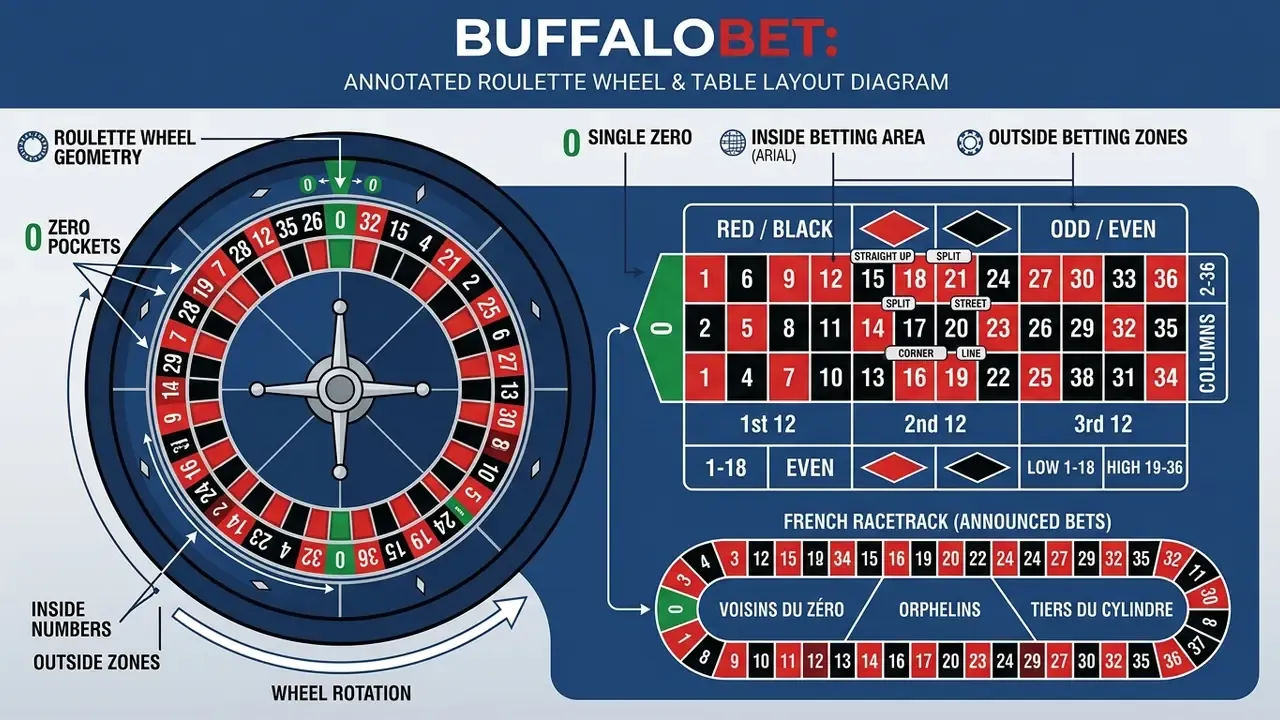
Anatomy of European (37 pockets), French (37 pockets) and American (38 pockets) wheels paired with the betting table grid and racetrack

The physical roulette wheel is a central rotating bowl fitted with engineered deflectors and track frets. Those obstacles make the ball bounce unpredictably before it drops into a numbered pocket. The accompanying roulette table provides a grid where players place bets using coloured chips, separating individual numbers (1 through 36) from broader groups such as colours or numerical ranges. Two surfaces, one game. Learn both and the rest follows quickly.

How we test and review roulette games at buffalobett.com

During our research into Australian market compliance at buffalobett.com, our editorial team analysed operational standards across remote gaming interfaces. We looked at how clear visual layouts reduce player confusion during high-speed betting rounds. By re-structuring game display reviews to highlight zero-pocket visibility and betting limit displays, we helped readers identify compliant operators that present transparent terms before real-money play begins.

Our assessment framework is deliberately terms-first. We document licensing disclosures, zero-pocket count, published payout schedules, bet-confirmation behaviour, withdrawal processing windows and identity verification (KYC) timelines before any promotional claim is repeated. Where an operator's stated bonus contribution for table games conflicts with its own terms and conditions page, we record the discrepancy rather than the headline.

European Roulette and American Roulette: Key Differences

European roulette features 37 pockets containing the numbers 1 to 36 plus a single green zero (0), which yields a structural house edge of 2.70%. American roulette adds a 38th pocket, the double zero (00), and that single addition lifts the house edge to 5.26% across standard wagers.

«For European roulette, a single zero yields a house edge of approximately 2.7%; the double zero in American roulette raises this to roughly 5.26%.» — Gaming Machine National Standard, VGCCC Commission Standards (2025). https://www.vgccc.vic.gov.au/games/gaming-machine-standards

+------------------------+------------------+------------------+
| Parameter              | European         | American         |
+------------------------+------------------+------------------+
| Total Pockets          | 37               | 38               |
| Zero Pockets           | Single Zero (0)  | Single & Double  |
|                        |                  | Zero (0, 00)     |
| House Edge (Standard)  | 2.70%            | 5.26%            |
| Straight-Up Win Odds   | 1 in 37 (2.70%)  | 1 in 38 (2.63%)  |
| Payout Ratio           | 35 to 1          | 35 to 1          |
+------------------------+------------------+------------------+

The double zero nearly doubles the casino's mathematical advantage without increasing the payout ratio for winning bets. A winning straight-up wager pays 35 to 1 on both variants, yet the extra pocket on the American wheel quietly reduces the true probability of hitting your chosen number from 2.70% down to 2.63%. Over a 1,000-spin session at $10 per spin, that structural difference translates into an expected loss of roughly $270 on a European wheel versus $526 on an American wheel. Same play, nearly double the cost. If a lobby offers both, the choice is not really a choice.

French Roulette: The Lowest House Edge Variant

French roulette uses the same 37-pocket single-zero wheel as European roulette, but it adds two exclusive rules that apply to even-money outside bets (Red/Black, Even/Odd, High/Low) when the ball lands on zero:

  1. La Partage ("The Divide"): if the ball lands on zero, players lose only half of their even-money stake, with the other 50% returned immediately. This reduces the effective house edge on those bets from 2.70% to 1.35%.
  2. En Prison ("In Prison"): instead of refunding half the bet, the original wager is locked "in prison" for the following spin. If the locked bet wins next spin, the player recovers the full original stake without any winnings attached.
+------------------------+------------------+------------------+----------------------+
| Parameter              | European         | American         | French (Even Money)  |
+------------------------+------------------+------------------+----------------------+
| Total Pockets          | 37               | 38               | 37                   |
| Zero Pockets           | Single Zero (0)  | Single & Double  | Single Zero (0)      |
| House Edge             | 2.70%            | 5.26%            | 1.35%                |
| Zero-Spin Outcome      | Full stake lost  | Full stake lost  | Half returned or     |
| (Even-Money Bets)      |                  |                  | held for next spin   |
+------------------------+------------------+------------------+----------------------+

Two practical caveats apply. First, La Partage and En Prison apply only to even-money outside bets; inside bets on a French wheel still face the standard 2.70% edge. Second, not every table labelled "French Roulette" actually implements both rules. Open the game information panel and confirm which zero rule is active before staking real money. It takes ten seconds and it halves the edge on half the bets you are likely to make.

How a Roulette Round Is Played

How a Roulette Round Is Played

A standard roulette round follows a strict sequence. The dealer opens the betting window, spins the roulette wheel and ball in opposite directions, announces "no more bets", waits for the ball to drop, then settles all table wagers.

  1. Betting window opens: players convert currency into table chips and place their bets on the layout.
  2. Wheel and ball launch: the human dealer or automated mechanism spins the wheel clockwise and launches the ball counter-clockwise along the outer track.
  3. No more bets announcement: as the ball slows and falls toward the deflectors, the dealer calls "no more bets" (or rien ne va plus), locking the table interface. After that call, no new wagers may be placed and existing chips cannot be moved.
  4. Outcome determination: the ball settles into a pocket. The dealer calls the winning number and colour, then places a marker (the dolly) on the winning table cell.
  5. Payout settlement: losing chips are cleared from the board, and winning wagers are paid according to the published payout schedule.

In online roulette the same five steps run on a countdown timer instead of a croupier's voice. RNG tables often compress the whole cycle into three to five seconds, which is worth remembering before you settle into a long session.

Roulette Rules: How to Place Bets

Roulette rules state that a bet is valid only when chips are properly positioned on the table layout before the dealer formally closes the betting window. Players select chip denominations and place them within the grid lines to indicate single numbers, shared borders, or outer group conditions.
1
Select your table and chips: choose a roulette variant with clear table limits, then acquire chips in your preferred denomination.
2
Position your bet: place chips cleanly on the desired grid number, intersection line, or outer category box before the spin starts.
3
Confirm the wager: in online or live casino interfaces, select the "Confirm" button if the game requires it before the betting timer expires.
4
Observe the spin: let the wheel spin conclude without attempting to alter or move existing chips on the table.
5
Verify the settlement: compare the dealer's marker or digital outcome banner against your chip placement, then check the payout against your balance.
Under Australian technical regulations, such as Revision 12.1 of the Gaming Machine National Standard administered by the Victorian Gambling and Casino Control Commission (VGCCC), electronic and simulated table games must ensure that betting confirmation steps prevent accidental or unverified player entries before outcome generation. (Note: the precise wording of the bet-confirmation clause should be verified against the published standard text; the VGCCC administers the national standard together with the Victorian Appendix.)

«Revision 12.1 of the Gaming Machine National Standard, together with a 2025 Victorian Appendix, comes into effect on 1 August 2026.» — VGCCC Commission Standards, Revision 12.1 (2025). https://www.vgccc.vic.gov.au/games/gaming-machine-standards

Inside and Outside Roulette Bets

Inside bets sit directly on individual numbers or small number groupings inside the main numbered grid, offering higher payout ratios but lower winning probabilities. Outside bets sit on the larger boxes surrounding the grid, covering broad categories such as red/black or odd/even with better odds of winning and shorter returns.

+-------------------+-----------------+----------------+--------------------+
| Bet Category      | Bet Type        | Numbers Covered| Standard Payout    |
+-------------------+-----------------+----------------+--------------------+
| Inside            | Straight Up     | 1              | 35 to 1            |
| Inside            | Split           | 2              | 17 to 1            |
| Inside            | Street          | 3              | 11 to 1            |
| Inside            | Corner          | 4              | 8 to 1             |
| Inside            | Six Line        | 6              | 5 to 1             |
| Outside           | Dozen / Column  | 12             | 2 to 1             |
| Outside           | Red / Black     | 18             | 1 to 1             |
| Outside           | Even / Odd      | 18             | 1 to 1             |
| Outside           | High / Low      | 18             | 1 to 1             |
+-------------------+-----------------+----------------+--------------------+

Inside wagers suit players chasing a larger return per spin, though they bring far greater bankroll volatility. Outside wagers pay less but cover up to 48.6% of all available outcomes on a European wheel, which makes them the usual choice for structured bankroll pacing. Neither category is "better" in a mathematical sense: both carry the same 2.70% edge on a single-zero wheel. What changes is how quickly your balance moves.

Announced or Call Bets The French

Announced or Call Bets: The French Racetrack Layout

Alongside the standard grid, European and French roulette interfaces include an oval "racetrack" betting area. These announced or "call" bets cover specific physical sectors of the wheel rather than numerical ranges printed on the table:
  • Voisins du Zéro (Neighbours of Zero):covers the 17 numbers surrounding the zero pocket (22, 18, 29, 7, 28, 12, 35, 3, 26, 0, 32, 15, 19, 4, 21, 2, 25) using 9 chips placed as a combination of splits, corners and a trio.
  • Tiers du Cylindre (Third of the Wheel):covers the 12 numbers opposite zero (27, 13, 36, 11, 30, 8, 23, 10, 5, 24, 16, 33) using 6 split bets.
  • Orphelins (Orphans):covers the remaining 8 numbers not included in Voisins or Tiers (1, 20, 14, 31, 9, 17, 34, 6) using 5 chips, one straight-up and four splits.
  • Neighbours (Voisins):lets a player back one chosen number plus two adjacent numbers on either side of it as they appear on the physical wheel, typically 5 chips in total.

Announced bets do not improve the mathematical return. Each chip inside the pattern still pays at its standard inside-bet ratio and remains subject to the same 2.70% edge, or 1.35% where La Partage applies to even-money wagers. Their value is ergonomic: one click places a nine-chip pattern inside a very short betting window.

Roulette Bets, Payouts and Odds. Roulette

Roulette Bets, Payouts and Odds

Roulette payouts are built around a 36-number ratio, which creates an intentional gap between the payout and the true wheel probability. That gap is the house edge. On a single-zero wheel with 37 pockets, the true odds of hitting a straight-up wager are 1 in 37, yet the payout stays fixed at 35 to 1.

Expected Value (EV) per $1 Straight-Up Bet (European Wheel):
EV = (1/37 * $35) + (36/37 * -$1) 
EV = $0.9459 - $0.9730 = -$0.0270 (-2.70%)

Expected Value (EV) per $1 Straight-Up Bet (American Wheel):
EV = (1/38 * $35) + (37/38 * -$1)
EV = $0.9211 - $0.9737 = -$0.0526 (-5.26%)

This fixed statistical disparity means that over thousands of spins the casino retains an average of $2.70 for every $100 wagered on a European table, and $5.26 on an American table. As documented in technical standard guidelines published by the State of Connecticut's Gaming Division, independent testing laboratories verify that random outcome generators conform to these precise statistical distributions at a 99% confidence level over 10,000 test spins.

«Independent test laboratories must review source code for core randomness algorithms and examine for bias, implementation errors, or malicious code affecting fair play.» — Connecticut Department of Consumer Protection, Gaming Division Technical Standards for Online Casino Platforms. https://portal.ct.gov/DCP/Gaming-Division

Why do roulette odds matter in practice? Because the edge determines how long a given bankroll survives, not whether a single spin wins. A $200 balance on a European wheel at $5 flat bets faces a theoretical cost of about 13.5 cents per spin. The same balance on an American wheel loses roughly 26 cents per spin. Same excitement, different burn rate.

[⚙️ INTERACTIVE WIDGET SPECIFICATION: Roulette Bet Calculator & EV Evaluator]
- Input 1: Game Variant Dropdown [European (2.70% HE) | American (5.26% HE) | French even-money (1.35% HE)]
- Input 2: Bet Type Selection [Straight Up | Split | Street | Corner | Six Line | Dozen/Column | Outside Even-Money]
- Input 3: Stake Amount (AUD)
- Output Display:
  * Winning probability (%)
  * Payout ratio (x to 1)
  * Expected profit/loss per 100 spins (AUD)
  * Session bankroll depletion estimate at chosen stake
- Accessibility: keyboard-navigable inputs, ARIA labels, results mirrored as plain text for screen readers.

The practical consequence of that enforcement pattern is simple. An offshore roulette site reachable today may be blocked at internet-service-provider level within weeks. Balances held with an unlicensed operator carry no Australian consumer protection, no independent dispute resolution pathway and no guaranteed withdrawal route once access is severed. That is not a theoretical risk; it is a recurring complaint pattern.

Responsible Gambling Tools Check These Before

Responsible Gambling Tools: Check These Before Your First Spin

  • Deposit limits:daily, weekly and monthly caps that you set yourself and that cannot be raised instantly.
  • Loss and session-time limits:automatic session reminders and forced breaks in play.
  • Cooling-off periods:short-term account freezes, usually from 24 hours to 30 days.
  • Self-exclusion:long-term account closure. For licensed Australian wagering services this includes the national BetStop register.
  • Reality checks and activity statements:periodic on-screen prompts showing elapsed time and net position.
  • Support services:Gambling Help Online and the national helpline on 1800 858 858, available 24/7.
Who Should Skip Online Roulette Entirely

Who Should Skip Online Roulette Entirely

Roulette is entertainment with a mathematically guaranteed negative return. Skip it if any of the following apply: you are under 18; you are chasing losses from a previous session; you are wagering money set aside for rent, bills or debt repayment; you are relying on a betting system to "recover" funds; you are drinking or using substances while playing; or you are registered with a self-exclusion scheme.

Speed deserves a separate warning. Fast RNG roulette can complete 400 to 700 spins per hour, which compresses the house edge into a very short window. The theoretical loss on a $5 flat bet at 500 spins per hour on a European wheel is roughly $67.50 an hour. Live dealer tables run at around 45 to 60 spins per hour, so the same stake costs closer to $7 an hour. Pace is a risk setting, even though no lobby labels it that way.

Roulette Demo, Online Casino or Live Dealer Roulette?

Choosing between a roulette demo, a random number generator (RNG) online casino game and live dealer roulette depends on what you want from the session: risk-free practice, fast automated rounds, or real-time human dealing.

«In 2024, sports betting had the largest proportion of online gambling, with 94.2% of sports betting occurring online; race betting followed at 67.9%.» — Gambling Participation in Australia 2024: Trends over Time, and Profiles Associated with Online Gambling, Australian National University. https://rsph.anu.edu.au

That migration of wagering activity to digital channels is exactly why format literacy matters. The same game name can describe three very different products, with different speeds, limits and verification mechanisms behind them.

Feature / CriteriaRoulette DemoRNG Online RouletteLive Dealer Roulette
Real Money StakesNo (virtual credits)YesYes
Dealer TypeNone (software simulator)None (RNG engine)Human croupier
Outcome EngineSoftware RNG / static mathsCertified software RNGPhysical wheel and ball stream
Average Round SpeedVery fast (instant spin)Fast (3 to 5 seconds)Moderate (45 to 60 seconds)
Minimum Bet Limits$0 (free play)Low ($0.10 to $1.00)Moderate to high ($1 to $5+)
Maximum Bet LimitsNot applicableLower table ceilingsTypically higher ceilings
InteractionNoneNoneCroupier chat, tipping, shared table
Primary PurposePractice and rules learningFast solo gamingImmersive casino experience

RNG online games and live dealer tables both use real money, yet they run under different pacing and verification rules. RNG games depend entirely on audited mathematical algorithms; live dealer tables broadcast physical equipment from dedicated production studios. In practice, most live roulette tables you will meet come from a small group of studio suppliers, with Evolution, Pragmatic Play Live and Playtech among the largest. Spotting the supplier logo in the lobby is a quick shortcut to knowing which ruleset, racetrack layout and side-bet menu you are about to face.

Why Start with Roulette Demo. Playing

Why Start with Roulette Demo

Playing a roulette demo lets you inspect table controls, read payout tables and test betting layouts without risking your own funds.

Demo modes run on virtual practice credits, so a beginner can misplace a split bet or miscalculate dozen coverage with zero financial consequence. Useful, and free. Just remember that a winning demo run does not alter the underlying house edge or predict anything about real money roulette.

Use demo play deliberately rather than idly. A productive 20-minute session should confirm four things: where the zero pockets sit in the interface, how long the betting window lasts, whether the table applies La Partage on zero, and how the game displays minimum and maximum limits for each bet type. Write those four answers down if it helps. I still do it when reviewing an unfamiliar supplier.

What Live Dealer Roulette Adds

Live dealer roulette replaces computer graphics with a real physical wheel operated by a trained croupier, broadcast through high-definition video with interactive chat.

The live casino format uses optical camera recognition (OCR) technology to translate the physical ball drop into digital screen data almost instantly. Overseas remote gambling standards, such as those maintained by the UK Gambling Commission (UKGC RTS 14), set strict rules for live streams to ensure continuous camera coverage, which prevents edited loops or delayed feeds from compromising session transparency.

Live Interface Functionality Chat, Saved Bets

Live Interface Functionality: Chat, Saved Bets and Multipliers

Modern live tables offer interface features well beyond simple video streaming:
  • In-game croupier chat:real-time text interaction, useful for requesting a rules clarification or submitting announced bets that the croupier places for you. Professional croupiers answer verbally through studio microphones, which is the closest digital equivalent to table etiquette in a land-based venue. Chat is moderated, and abusive messages usually trigger an immediate table ban.
  • Custom bet saving and favourite layouts:digital overlays let you save complex multi-chip patterns, a full Voisins du Zéro spread for example, for one-click placement inside a betting window that may last only 15 seconds.
  • Statistics panels and hot/cold displays:most tables show the last 100 to 500 results plus heat maps. These are presentation features only. They carry no predictive value, because each spin is independent.
  • Multiplier side bets (Lightning, Quantum and similar formats):game-show style variants apply random multipliers, commonly between 50x and 500x, to selected straight-up numbers after bets lock. Crucially, the standard straight-up payout is reduced to fund the mechanic, often from 35:1 down to 29:1, which pushes the overall house edge above the 2.70% baseline. Read the return-to-player disclosure before assuming a multiplier table offers better value.

Roulette Strategy and Betting Systems: What They Change

A roulette strategy or betting system changes the size and progression of your wagers across spins. It cannot change the fixed mathematical house edge, and it cannot guarantee a long-term win.

💬 Fact Check: The Mathematical Reality of Progression Systems

A common misconception among new players is that doubling wagers after a loss, as in the Martingale system, guarantees a positive return over time.

Probability theory confirms that every roulette spin is an independent event; previous outcomes do not influence future drops. That misreading has a name: the Gambler's Fallacy. On top of that, table betting maximums and finite player bankrolls create absolute ceilings that stop progression systems dead during extended losing streaks.

"No betting sequence can transform a negative expected value game into a profitable one over a long sample size." — Claire Bennett, Senior iGaming Content Editor

Consider the classic Martingale applied to

Consider the classic Martingale applied to an outside Red/Black bet on a European table, where the win probability is 48.6%:

Base Bet: $10 on Red
Spin 1: Loss (Black) -> Next Bet: $20
Spin 2: Loss (Black) -> Next Bet: $40
Spin 3: Loss (Black) -> Next Bet: $80
Spin 4: Loss (Black) -> Next Bet: $160
Spin 5: Loss (Zero)  -> Next Bet: $320
Cumulative Loss after 5 Spins: $310
Required Bet on Spin 6 to recover $10 profit: $320

Long losing runs are not exotic, either. On a European wheel a single even-money bet loses with probability 19/37, so ten consecutive losses carry a probability of (19/37)¹⁰ ≈ 0.00046. Small per sequence, yes, and close to inevitable across repeated sessions of several hundred spins. The mechanism that breaks the progression is structural rather than a statistical curiosity: outcomes are independent, so no accumulated deficit is ever "owed" back to the player.

«Tests applied to RNG output must assure conformance to the intended distribution of values and statistical independence between consecutive draws.» — Connecticut Department of Consumer Protection, Gaming Division Technical Standards for Online Casino Platforms. https://portal.ct.gov/DCP/Gaming-Division

When a player hits the casino's

When a player hits the casino's maximum table limit or runs out of bankroll, the Martingale collapses, and a single collapse wipes out dozens of small prior gains. A table with a $10 minimum and a $500 maximum permits only six doublings. Six. Runs of that length appear far more often than most players intuitively expect.

Other popular systems such as Fibonacci or D'Alembert adjust stakes more gradually, yet they carry the identical constraint: they redistribute short-term variance without touching the 2.70% or 5.26% house advantage. The D'Alembert raises the stake by one unit after a loss and lowers it by one after a win, which softens the escalation curve but stretches the recovery horizon. The Fibonacci sequence (1, 1, 2, 3, 5, 8, 13 and so on) does much the same with a slightly steeper slope. Neither changes the sign of the expected value.

Flat and Pattern-Based Systems: James Bond and Andrucci

Beyond mathematical progressions, players use flat-betting coverage patterns and statistical tracking. Both are often promoted as "smarter" alternatives. Both remain bound by the same edge.

The James Bond Strategy Flat-Bet Coverage

The James Bond Strategy (Flat-Bet Coverage)

Popularised through Ian Fleming's fiction, this approach commits a fixed $200 total stake per spin, spread across three sectors of a European table:

  • $140 on High Numbers (19 to 36), paying 1:1, for a net profit of $80
  • $50 on the Six Line (13 to 18), paying 5:1, for a net profit of $100
  • $10 straight up on Zero (0), paying 35:1, for a net profit of $160

Where it fails mathematically: of the 37 outcomes on a European wheel, 25 numbers return a profit and 12 numbers (1 through 12) lose the entire $200 stake. Weight each outcome by its probability and you land on exactly the same −2.70% expectation as any other combination of European roulette bets. The strategy converts a small number of large losses into a large number of small wins. That is a psychological reframing, not an edge.

The Andrucci System Chaos Theory and

The Andrucci System (Chaos Theory and "Hot" Numbers)

The Andrucci System leans on short-term variance. Players record 30 to 37 historical spins to identify "hot" numbers, meaning pockets that hit more than once, then place straight-up bets on those numbers for the following 30 to 36 spins.

Where it fails mathematically: clustering is the expected behaviour of a random process over small samples, not evidence of a mechanical tendency. Because each spin is independent, and certified wheels and RNGs are calibrated to a uniform distribution, past frequency carries no forward information. The system also concentrates the bankroll into 35:1 propositions, which sharply increases variance and the probability of ruin inside a single session.

So what does work? Nothing improves the edge except variant selection: a French table with La Partage, then a single-zero European wheel, then nothing else. Everything after that is bankroll management and session discipline.

How to Choose a Roulette Casino

How to Choose a Roulette Casino and Play for Real Money

Selecting a platform for real money roulette means checking regulatory compliance, verified payout practices, explicit bonus terms and working responsible gambling tools. In that order.

To help adult players make informed decisions, our editorial team at buffalobett.com ran a systemic audit of review frameworks for casino platforms. We examined how promotional claims distort player perception of bonus value. By enforcing terms-first reporting standards that highlight game weighting restrictions and identity verification (KYC) timelines, we gave readers objective criteria for filtering out unverified operators.

When inspecting any brand offering online or live roulette, apply this verification checklist:

Buffalobet heading-banner
  • Licensing and ownership:confirm that the operator clearly displays valid licensing details from a recognised regulatory jurisdiction, including the licence number and the registered corporate entity.
  • Game weighting for bonuses:check how roulette wagers contribute to wagering requirements. Table games often contribute as little as 5% to 10%, so a $10 roulette bet may clear only $1.00 of wagering debt.
  • Withdrawal limits and fees:review processing times and maximum monthly withdrawal caps before you transfer real money.
  • Safer gambling infrastructure:make sure you can set daily, weekly or monthly deposit limits from your account settings before the first spin, not after it.
  • KYC timelines:confirm which documents are required and whether verification happens at registration or only at first withdrawal. Late-stage KYC is the single most common cause of delayed payouts.
  • Game supplier transparency:identify the studio behind each roulette table and check that return-to-player figures appear in the game information panel.
  • Complaint history:search the brand name alongside terms like "withdrawal delay" or "account closed" and read the operator's own responses, not just the accusations.

The best roulette lobby, judged honestly, is the one with a verifiable licence, a single-zero or French wheel, published limits and a payout record you can check. Not the one with the biggest banner.

Pre-Deposit Checklist (Five Points)

  1. Licence number and regulator named in the site footer, and verifiable on the regulator's own register.
  2. Deposit limit set before the first transaction.
  3. Roulette's bonus contribution percentage and any maximum-bet-while-bonus-active clause read in full.
  4. Withdrawal method, minimum withdrawal amount and stated processing window confirmed.
  5. Self-exclusion and cooling-off controls located inside the account dashboard.

Payments, Withdrawals and Bonus Terms in Australia

Since the June 2024 restrictions, credit cards and digital currencies are prohibited as funding methods for licensed online wagering in Australia. That removes the two channels many players previously defaulted to, so the remaining options deserve a closer look.

+---------------------+------------------+--------------------+---------------------------+
| Method              | Deposit Speed    | Withdrawal Window  | Notes                     |
+---------------------+------------------+--------------------+---------------------------+
| PayID / Osko        | Instant          | Same day – 24 hrs  | Bank-to-bank, no card     |
| Debit card (Visa/MC)| Instant          | 1–3 business days  | Debit only; credit banned |
| Bank transfer       | 1–2 business days| 2–5 business days  | Highest limits, slowest   |
| e-wallets (where    | Instant          | Hours – 24 hrs     | Availability varies by    |
| permitted)          |                  |                    | operator and licence      |
| Prepaid vouchers    | Instant          | Not available for  | Deposit-only; withdrawal  |
| (e.g. Neosurf)      |                  | withdrawals        | routed to bank            |
| Credit cards        | BANNED           | BANNED             | Prohibited since June 2024|
| Digital currencies  | BANNED           | BANNED             | Prohibited since June 2024|
+---------------------+------------------+--------------------+---------------------------+

Figures are indicative ranges reported by operators and vary by platform, verification status and banking hours. Always confirm current limits and processing times in the cashier section of the specific site, and note that method availability differs between licensed Australian wagering services and other jurisdictions.

One quiet detail catches people out: prepaid vouchers accept deposits but cannot receive withdrawals, so a payout has to be routed to a bank account that matches your verified identity. If the names do not match, expect a hold.


Bonus Terms Checklist for Roulette Players

Bonus Terms Checklist for Roulette Players

  • Game weighting:roulette typically contributes 5% to 10% toward wagering, and some promotions exclude it entirely at 0%.
  • Maximum bet while a bonus is active:commonly capped between $5 and $10 per spin. Breaching the cap can void the bonus and any winnings attached to it.
  • Prohibited betting patterns:many terms explicitly forbid low-risk coverage, such as backing red and black at the same time, or covering more than a set percentage of the layout.
  • Wagering multiple and expiry:calculate the real turnover required. A $100 bonus with 30x wagering at 10% roulette weighting demands $30,000 in roulette turnover, not $3,000.
  • Maximum cash-out from bonus funds:frequently capped at a multiple of the bonus amount.

The conclusion is blunt. Roulette is one of the least efficient games for clearing a bonus. If your goal is bonus conversion, read the weighting table first. If your goal is playing roulette, consider declining the bonus altogether to avoid its bet-size restrictions.

Roulette FAQ: Is Live Roulette Actually Live and Are Tables Fixed?

Is live dealer roulette actually live?

Yes. Live dealer roulette offered by licensed operators is broadcast in real time using physical equipment operated by human croupiers.

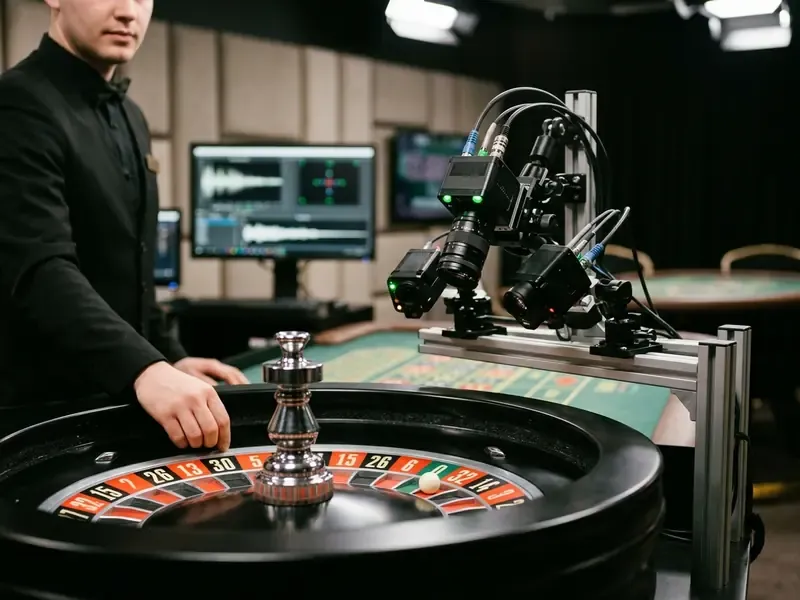
Inside a live casino studio: Physical spin mechanics synced with real-time digital screens

Licensed studios use continuous multi-angle HD cameras, real-time dealer interaction and cryptographic timestamping so that video feeds cannot be looped or pre-recorded. Regulators also inspect production studios periodically to confirm that physical roulette wheels meet exact mechanical balance standards.

«Independent test laboratories must review source code for core randomness algorithms and examine for bias, implementation errors, or malicious code.» — Connecticut Department of Consumer Protection, Gaming Division Technical Standards for Online Casino Platforms. https://portal.ct.gov/DCP/Gaming-Division

You can verify liveness yourself, too. Ask the croupier a specific question in chat and see whether the verbal answer matches, then cross-check the displayed result history against the dolly placement visible on the studio table.

Are live roulette tables fixed

Are live roulette tables fixed?

No. Regulated live roulette tables are not fixed or rigged. They depend on physical wheel dynamics and are continuously monitored by automated statistical software that flags mechanical bias.

An extensive empirical study conducted by Betting Data Lab assessed roulette wheel performance across multiple venues using chi-square statistical tests over tens of thousands of spins. The research found that genuine physical bias, caused by mechanical wear or track imperfections, appears in less than 2% of modern wheels. Casinos also run automated spin-tracking systems that flag distributional anomalies within an average of 12 days, prompting rebalancing or replacement before any structural advantage can be exploited.

The same analysis noted that individual numbers can naturally fluctuate between roughly 2.1% and 3.4% observed frequency with no physical defect present, and that samples of around 1,000 spins produce false positives a substantial share of the time. That is precisely why short-run "hot number" tracking is unreliable.

(Source note: the Betting Data Lab dataset is cited as published analysis; readers seeking the underlying methodology should request the full sample documentation directly from the publisher.)

In illegal or unlicensed online environments the picture changes. Without regulatory oversight, games may carry no independent RNG certification at all. Check the regulatory status of any site and avoid unverified offshore operators.

Which roulette variant gives the best odds?

French roulette with the La Partage rule offers the lowest house edge at 1.35% on even-money bets, followed by European roulette at 2.70%, with American roulette the least favourable at 5.26%. Where a French table is unavailable, a single-zero European wheel is always preferable to a double-zero American wheel.

Does roulette count toward casino bonus wagering?

Usually only partially. Table games including roulette commonly contribute between 0% and 10% of turnover toward wagering requirements, compared with 100% for most slots. Check the promotional terms for the exact weighting and for any maximum-bet clause that applies while bonus funds are active.

Can tracking previous results improve my chances?

No. Certified RNGs and calibrated physical wheels produce statistically independent outcomes, so past results carry no predictive information. Result history panels and hot/cold displays are interface features, not analytical tools.

Interactive casino-style gaming, including online roulette, is restricted under the Interactive Gambling Act 2001, and the ACMA actively blocks unlicensed offshore operators that target Australian residents. Legal status differs from wagering on sports and races, which is licensed and regulated separately. Verify the current position with the ACMA and your state or territory regulator before playing.

How fast should a roulette withdrawal be?

For licensed services, PayID and Osko payouts often land the same day or within 24 hours, while debit card returns take one to three business days and bank transfers two to five. Anything materially slower than the operator's own published window is worth querying with support in writing, and worth documenting if you later need dispute resolution.

Appendix A Editorial Change Log

Appendix A: Editorial Change Log

  • Superseded citation:an earlier version of this guide attributed the claim that "a sequence of 6 to 10 consecutive losses occurs regularly within normal variance over a 10,000-spin sample" to the Betting Data Lab wheel-bias analysis. That publication examines mechanical wheel bias detection rather than progression-system loss streaks, so the attribution has been withdrawn. The Martingale section now presents the losing-streak probability as a direct calculation, (19/37)¹⁰ ≈ 0.00046 for ten consecutive even-money losses on a European wheel, supported by the independence-of-draws requirement in the Connecticut Gaming Division technical standards.
  • Verification pending:the specific bet-confirmation requirement attributed to Revision 12.1 of the Gaming Machine National Standard is flagged for direct confirmation against the published standard text and the 2025 Victorian Appendix.
  • Structure:the Australian regulatory notice and responsible gambling tools were moved ahead of the format comparison, so that legal and safety context precedes any real-money guidance.
Red Flags When to Walk Away

Red Flags: When to Walk Away From a Roulette Casino

  • No licence number, or a licence number that does not appear on the regulator's public register.
  • Bonus terms hosted on a separate page with a different date to the promotion itself, or terms that change without notice.
  • A maximum cash-out clause buried below the sign-up button rather than beside the bonus amount.
  • Withdrawal requests that trigger a first-time document request weeks after registration, especially when the operator collected nothing at sign-up.
  • Support that answers bonus questions instantly but goes quiet on withdrawal timelines.
  • Multiplier roulette tables advertised as "better value" with no published return-to-player figure.
  • Any site offering credit card or digital currency deposits while presenting itself as a licensed Australian wagering service.

One red flag is a reason to slow down. Two or more is a reason to close the tab.

Responsible gambling: Gambling involves risk and should never be treated as a source of income. If gambling is causing harm to you or someone you know, free and confidential support is available through Gambling Help Online and the national helpline on 1800 858 858, 24 hours a day. Australian residents can register for national self-exclusion from licensed online and phone wagering services through BetStop. This article is intended for readers aged 18 and over and provides general information only.